Astrology raises one of its most fundamental questions: is a birth chart a matter of destiny, or do we truly have free will? Let’s explore different perspectives and see whether we can find an answer.
As the famous song says, “People are made this way—they want to know, they want to know, they want to know what lies ahead.” And that is certainly true. On the one hand, people consult astrologers because they want to glimpse the future. As a result, it is easy to conclude that if certain events can be predicted, they must be inevitable. On the other hand, there is a completely different point of view: if life follows a single predetermined script, what is the point of making choices at all? Wouldn’t free will simply be an illusion?
In reality, things are far less straightforward. Finding a balance between these two extremes is not easy—it largely depends on the lens through which you view the world.
Let’s examine this question from three different perspectives.
1. Astrology and Science: Does Free Will Exist?
From the standpoint of mainstream science—particularly astrophysics—there is no established mechanism by which distant planets could influence a person’s character or destiny. No known gravitational or electromagnetic force is capable of “writing” someone’s personality. Instead, who we are is shaped by genetics, upbringing, environment, and personal experience. When horoscopes seem surprisingly accurate, science typically attributes this to cognitive biases: the human mind is remarkably good at finding patterns, even where none exist.
There is, however, an important caveat. This is the position of science as it exists today. History has repeatedly shown that human knowledge has its limits, and what lies beyond today’s horizon may become obvious tomorrow. It is entirely possible that such a mechanism exists—we simply do not yet have the tools to detect it.
✅ Conclusion: Since no physical mechanism has been identified, there is no “cosmic sentence” in the classical sense. You remain free to choose who you are and how you act. That said, this reflects only our current understanding. Who knows—perhaps in twenty years scientists will discover a new field that carries the energy of destiny. 😉
If science so convincingly argues that astrology lacks scientific foundations, why do horoscopes still seem to work? Perhaps the answer lies not in astrophysics, but in the way our minds operate.
2. The Psychology of Astrology: Why Do Horoscopes Seem to Work?
Imagine this: on your way to work, you hear a horoscope on the radio saying, “Today, conflicts are likely.” Instead of going through an ordinary workday, you suddenly notice every sarcastic remark from your colleagues—and before long, you find yourself in an argument. The future was not predicted for you; you created it yourself.
This is where the Barnum effect comes into play. Our minds naturally seek confirmation to reduce uncertainty, focusing on events while waiting for the prediction to come true. Once we believe a forecast, we stop considering alternatives and begin acting according to the script it has suggested. In this sense, astrology works not as a mystical force but as a psychological catalyst—it reinforces our expectations and accelerates the outcomes we already believe in.
💡 Try this: Think of a time when your expectations influenced the outcome of an event.
✅ Conclusion: From a psychological perspective, astrology functions as a catalyst. It shapes expectations through the natal chart, boosts motivation, and sharpens focus in much the same way as visualisation techniques. The future is not magically “attracted”; rather, it is shaped by changes in your behaviour and attention.
But what if, like the old woman in the tale of the Golden Fish, we visualise success while life keeps confronting us with social, physical, or random limitations? What if a natal chart inspires us, yet our goals still remain out of reach?
3. The Classical Astrological Perspective: “Potential, Not a Sentence”
Most contemporary psychological astrologers argue that a horoscope represents both destiny and free will at the same time. Let’s see why.
The weather forecast analogy. A horoscope is often compared to a weather forecast. An astrologer may warn that “a storm is coming”—in other words, that a challenging period marked by difficult planetary aspects is approaching. But they are not saying you will definitely get soaked. You can stay indoors, take an umbrella, or go out wearing waterproof boots. Like the weather, the planets describe the conditions. How you respond to those conditions is your choice. Whether that choice is conscious or unconscious depends entirely on you.
Energy, not action. Astrology describes the quality and expression of energy. Mars symbolises initiative, drive, assertiveness, and physical energy. The same energy can become the successful career of a surgeon or a boxer—or it can erupt as a street fight. Choosing how to channel that energy is where free will comes in.
The karmic lesson. Within esoteric traditions, the natal chart is believed to reveal the lessons your soul has come to learn. Whether you embrace those lessons or ignore them is entirely up to you.
Still, some events remain beyond our control. They arrive regardless of our wishes—the kind that catch us on an ordinary Tuesday afternoon while we are sitting comfortably at home, leaving us with the unmistakable feeling that life will never be the same again. The energy surrounding such turning points is often clearly reflected in astrological forecasting. This is where the key distinction lies: the “cosmic sentence” is the event itself, which unfolds independently of us; our freedom lies in how we respond to it. We cannot always avoid the storm. But we can always decide how to weather it.
✅ Conclusion: A horoscope is a map for exploring the landscape of possibilities. Free will is not the absence of limitations—it is the ability to find the best path within them.
Conclusion
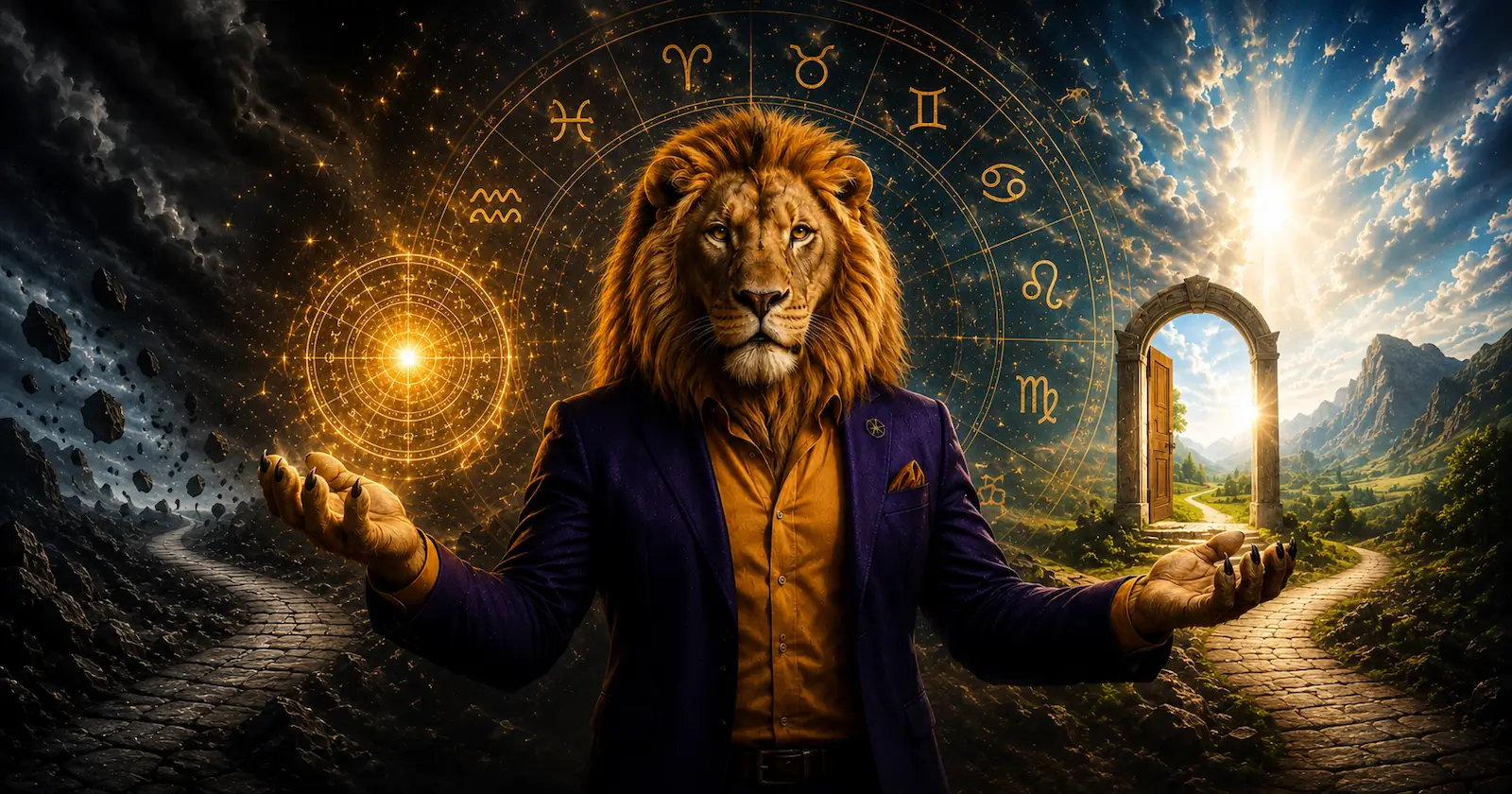
A horoscope represents freedom of choice within a corridor outlined by destiny. That corridor—your present range of possibilities—is what astrology seeks to describe.
Destiny consists of external circumstances such as health, your starting conditions, or your social environment—things that cannot be changed overnight. Think of it as the hand you are dealt in a card game.
Free will is how you choose to play those cards.
📜 The Golden Rule of Astrology
“The stars incline; they do not compel.”
(Stella agunt, non necessitant.)
If you treat a horoscope as a script that must be followed, you create your own trap of fatalism. But if you use it as a diagnostic tool for self-awareness—and consult it the way you would check a weather forecast—you gain the freedom to make conscious choices. As is so often the case, the truth lies not at either extreme, but in how you choose to play the hand you have been dealt.
Frequently Asked Questions
Can I change my destiny if my natal chart contains difficult aspects?
Yes. A natal chart may indicate challenging periods, suggesting that life is presenting you with an important test. Knowing this in advance allows you to prepare and face those challenges with awareness, making thoughtful decisions when they matter most.
Why do horoscopes often seem accurate if science rejects planetary influence?
Many people genuinely experience horoscopes as meaningful—whether psychologically or through predictive astrology. Otherwise, astrology would hardly have endured for thousands of years. At the same time, it is difficult to remain completely objective when interpreting forecasts or astrological psychology. The Barnum effect and other cognitive biases encourage us to recognise ourselves in broad statements, helping to reduce uncertainty. Used honestly and critically, however, astrology can become a valuable tool for self-reflection and personal insight.
Why study a horoscope if we have complete free will?
A horoscope can serve as a diagnostic framework, offering answers that might otherwise require years of observation and reflection. It helps organise personal experience, identify recurring behavioural patterns, and understand how those insights can support personal growth and help you become the best version of yourself.